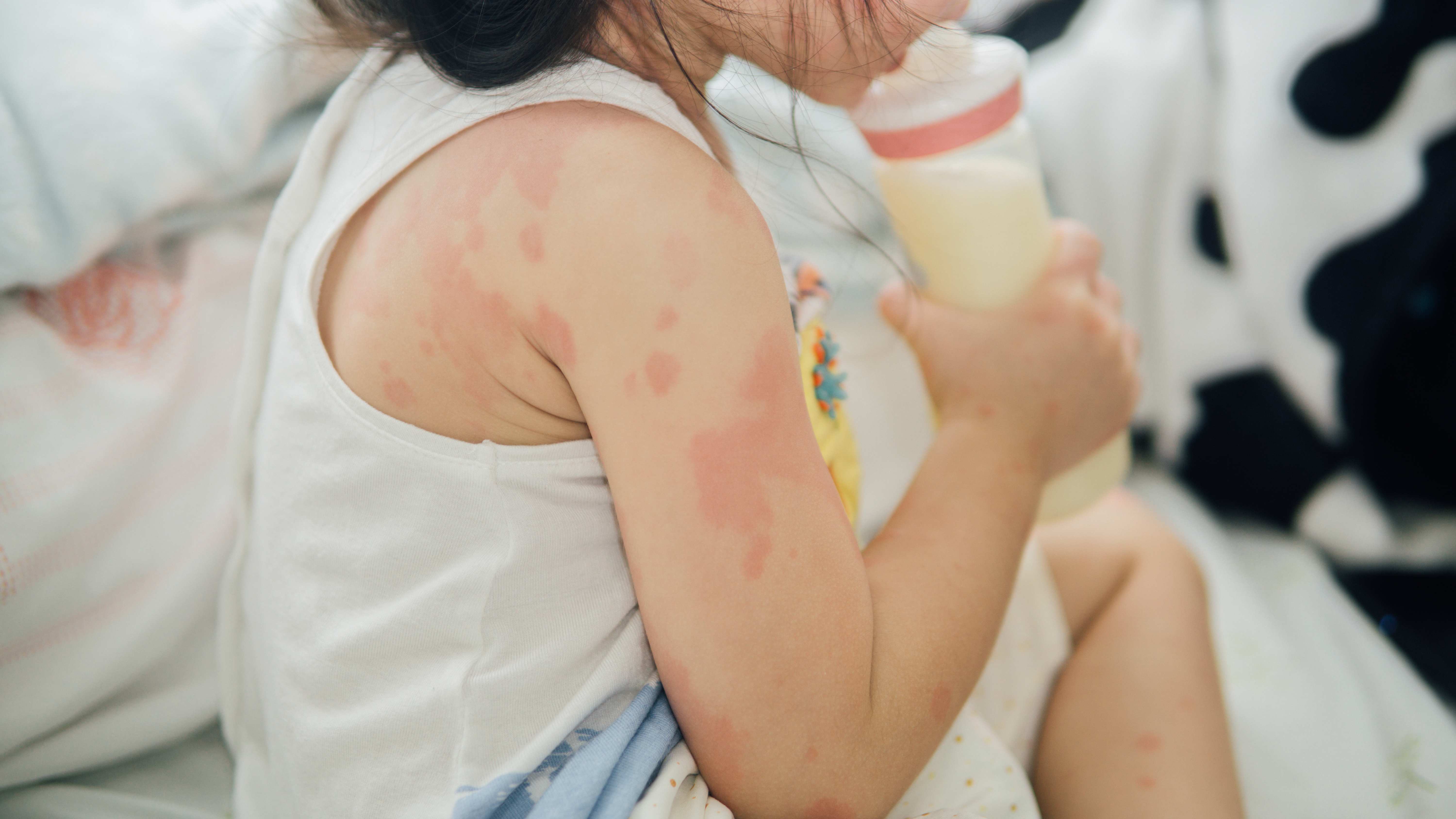
There are two main types of allergic reactions to cow’s milk proteins: reactions involving immunoglobulin E (IgE) antibodies (IgE-mediated) and reactions not involving IgE antibodies (non-IgE-mediated). There are also some conditions that include both IgE-mediated and non-IgE-mediated reactions, and these are called “mixed”.
IgE-mediated cow’s milk allergy
IgE-mediated cow’s milk allergy is one of the most common causes of IgE-mediated food allergy in children and can cause anaphylaxis. Read about specific considerations for infants and children with IgE-mediated cow’s milk allergy here: www.aboutkidshealth.ca/cowsmilkallergy.
Non-IgE-mediated cow’s milk allergy
Non-IgE-mediated cow’s milk allergies (CMAs) are the most common milk allergies in infants and children. Non-IgE CMAs are classified into three categories:
- Food protein–induced allergic proctocolitis (FPIAP)
- Food protein–induced enteropathy (FPE)
- Food protein–induced enterocolitis syndrome (FPIES)
The cause of non-IgE-mediated CMA is not clearly understood, but it is more common in children with family members who have a history of allergies, eczema and asthma. The reactions are generally delayed, occurring hours to days after a child eats something containing cow’s milk proteins. Parts of the immune system are activated by the proteins found in cow’s milk, causing inflammation in the intestines, but can also include the skin or respiratory (breathing) systems. The area of the gastrointestinal (gut), skin and/or respiratory systems, as well as severity of symptoms vary between types of CMA. Symptoms may include vomiting, diarrhea, poor weight gain, and blood and mucus in the stool.
Food protein–induced allergic proctocolitis (FPIAP)
Food protein–induced allergic proctocolitis (FPIAP) due to cow’s milk protein is the most common form of non-IgE-mediated CMA. In FPIAP, exposure to cow’s milk protein leads to inflammation in the rectum and in the last part of the colon, called the sigmoid colon.
Signs and symptoms
Infants or children with FPIAP often have blood and mucus in their stool. This can begin as streaks of blood at 2 to 8 weeks of age and can occur in both breastfed and formula-fed infants. Infants with FPIAP generally continue to feed well and gain weight.
Diagnosis
FPIAP is diagnosed based on history and physical examination. No specific blood tests or other investigations are needed. The diagnosis is confirmed when a baby’s symptoms improve after cow’s milk protein is removed from their diet.
Treatment
For formula-fed infants, cow’s milk formula should be replaced with a formula that is cow’s milk–free or extensively hydrolyzed (the proteins are broken down so they do not cause an immune reaction). Soy formula is not recommended for infants under the age of 6 months.
Exclusively breastfed infants should continue breastfeeding or receiving breast milk (i.e., expressed breast milk), but breastfeeding parents are advised to remove all sources of cow’s milk proteins from their diets, which includes dairy as well as any food or drink that has cow’s milk proteins in the ingredient list. A dietitian can help breastfeeding parents with a cow’s milk elimination diet. It can take days for milk proteins in a breastfeeding parent’s diet to be eliminated from breast milk and two to four weeks for symptoms to improve. If a breastfed infant still has symptoms weeks after the parent changes their diet, the parent can remove soy proteins and products from their diet and monitor for a change in symptoms. Further food eliminations are generally not encouraged to manage FPIAP.
For infants who are fed both formula and breast milk, replace the formula with a formula that is cow’s milk-free or extensively hydrolyzed (the proteins are broken down so they do not cause an immune reaction). As well, the breastfeeding parents are advised to remove all sources of cow’s milk proteins from their diets, which includes dairy as well as any food or drink that has cow’s milk proteins in the ingredient list.
In rare cases where the symptoms of a breastfed infant worsen despite eliminating cow’s milk proteins or soy, a health-care provider may recommend an amino acid formula and monitor symptoms. In such cases, the baby likely does not have FPIAP and will need to be seen by a paediatrician and/or paediatric gastroenterologist.
It is common for a little blood and mucus to appear in a baby’s stool when they have FPIAP, especially if the baby is sick with a cold or infection. This does not mean the baby needs to start an extensively hydrolyzed formula or the breastfeeding parent needs to further change their diet. Consult with a health-care provider about the need to make diet changes to manage FPIAP.
Long-term outcomes
Most children outgrow FPIAP between their first and second birthdays. Your child’s health-care provider will advise you on when and how to reintroduce cow’s milk proteins.
Food protein–induced enteropathy (FPE)
Food protein–induced enteropathy (FPE) due to cow’s milk proteins is rare. In FPE, exposure to cow’s milk proteins leads to inflammation of the small intestine.
Signs and symptoms
Infants with FPE often have diarrhea, poor weight gain and may have abdominal distention (swelling or bloating) and vomiting. Because of the inflammation in the small intestine, babies with FPE may have trouble absorbing nutrients.
Diagnosis
Infants and children in whom FPE is suspected will have blood and stool tests as well as an endoscopy and biopsy. During an endoscopy, a thin flexible tube with a camera on the end is inserted into the body to look at the small intestine. A biopsy involves taking small pieces of tissue from the small intestine to be examined under a microscope. These tests will help determine if the child has FPE or another condition that can cause diarrhea, poor weight gain or iron deficiency anemia.
Treatment
FPE is more common in formula-fed infants. The most common trigger foods in FPE are cow’s milk protein and soy. It is recommended to remove dairy- or soy-based formula and replace it with an extensively hydrolyzed formula (proteins are broken down so they do not cause an immune reaction) or, in some cases, an amino acid formula.
FPE is extremely rare in breastfed infants. Breastfed infants should continue breastfeeding, and breastfeeding parents are usually advised to remove all sources of cow’s milk proteins from their diets. Consult with a health-care provider before eliminating more than cow’s milk protein when breastfeeding or offering breast milk to an infant with FPE. It can take days for food proteins in a breastfeeding parent’s diet to be eliminated from breast milk, and at least two to four weeks for the intestinal inflammation to heal. A dietitian can help breastfeeding parents with a cow’s milk and/or soy protein elimination diet. If a breastfed infant still has symptoms after the parent changes their diet, the infant may be given a trial of an extensively hydrolyzed formula or, in some cases, an amino acid formula. It may take several weeks after these diet changes for the inflammation in the intestines to heal and for symptoms to improve. Children diagnosed with FPE may react to proteins from other foods, including soy, rice, poultry, egg, fish and shellfish. Consult with a health-care provider before eliminating more foods in your child’s diet.
Long-term outcomes
Most children outgrow FPE between their first and third birthdays. Your child’s health-care provider will advise you on when and how to reintroduce cow’s milk proteins.
Food protein–induced enterocolitis syndrome (FPIES)
Food protein–induced enterocolitis syndrome (FPIES) due to cow’s milk proteins is a rare form of non-IgE-mediated CMA. There are acute and chronic forms of FPIES.
Signs and symptoms
Acute FPIES
Infants and children develop symptoms two to four hours after drinking cow’s milk or eating food that contains cow’s milk protein. They usually have severe vomiting, pale skin, lethargy, sometimes diarrhea, and are at significant risk of dehydration. Symptoms last for a few hours.
Breastfed infants with acute FPIES often have milder symptoms.
Chronic FPIES
Infants and children develop symptoms that are less severe and develop more slowly than in acute FPIES, such as random (also known as intermittent) vomiting, diarrhea and poor weight gain.
Diagnosis
FPIES is diagnosed based on history and physical examination. No specific blood tests or other investigations are needed. In chronic FPIES, diagnosis is confirmed when a baby’s symptoms disappear after cow’s milk is removed from their diet (usually up to 10 days after a formula or diet change). Children with acute FPIES will also often have investigations done to check for other causes of severe illness, such as infection or bowel obstruction.
Treatment
Acute FPIES is considered a medical emergency. Immediate care in an emergency room involves intravenous (IV) fluids and medications.
FPIES is rare in breastfed infants. Breastfeeding parents of infants diagnosed with FPIES are advised to remove all sources of cow’s milk proteins from their diets.
For formula-fed infants, cow’s milk formula should be replaced with a formula that is extensively hydrolyzed (the proteins are broken down so they do not cause an immune reaction) or, in some cases, an amino acid formula. Soy formula is not recommended because infants with FPIES may also react to soy protein.
Infants and children diagnosed with acute FPIES may react to proteins from other foods, including rice, oats and fish. Infants and children diagnosed with chronic FPIES may react to soy proteins. Consult with a health-care provider before eliminating more foods in your child’s diet.
FPIES requires close monitoring of weight gain and nutrition after cow’s milk or other food proteins are removed.
Long-term outcomes
Most children outgrow FPIES by the age of 6 years. Reintroducing cow’s milk or other proteins in children with FPIES can be considered under close supervision by a physician. This is often done as an oral food challenge.
Re-introducing cow’s milk proteins in your child’s diet
Reintroducing cow’s milk proteins may be done at home or in a health-care provider’s office. Talk to your child’s health-care provider about when, and how, to safely reintroduce cow’s milk proteins into your child’s diet.
When to see a health-care provider
Consult your child’s health-care provider if your child has increased blood in their stool or if they develop diarrhea. Children with CMA should have their weight and nutritional status monitored by their health-care provider.
When to take your child to the nearest Emergency Department
Children with acute FPIES have sudden-onset and severe symptoms, including very frequent vomiting, diarrhea, pale skin and lethargy, and are at risk of dehydration. If your child has these symptoms, bring them to a hospital immediately.
Resources
Health Canada: Milk — A priority food allergen
https://www.canada.ca/en/health-canada/services/food-nutrition/reports-publications/food-safety/milk-priority-food-allergen.html
Food Allergy Canada: Milk
https://foodallergycanada.ca/allergies/milk/
Food Allergy Canada: FPIES
https://foodallergycanada.ca/food-allergy-basics/related-conditions/food-protein-induced-enterocolitis-syndrome-fpies/
References
Canadian Paediatric Society (June 25, 2024). Cow’s milk protein allergy in infants and children. Retrieved from https://cps.ca/en/documents/position/cows-milk-protein-allergy.
Groetch, M., et al. (2025). Clinical Presentation and Nutrition Management of Non-IgE-Mediated Food Allergy in Children. Clinical & Experimental Allergy, 55:213-225.
Vandenplas, Y., et al. (2024). An ESPGHAN Position Paper on the Diagnosis, Management and Prevention of Cow's Milk Allergy. JPGN, 78(2):386-413.